
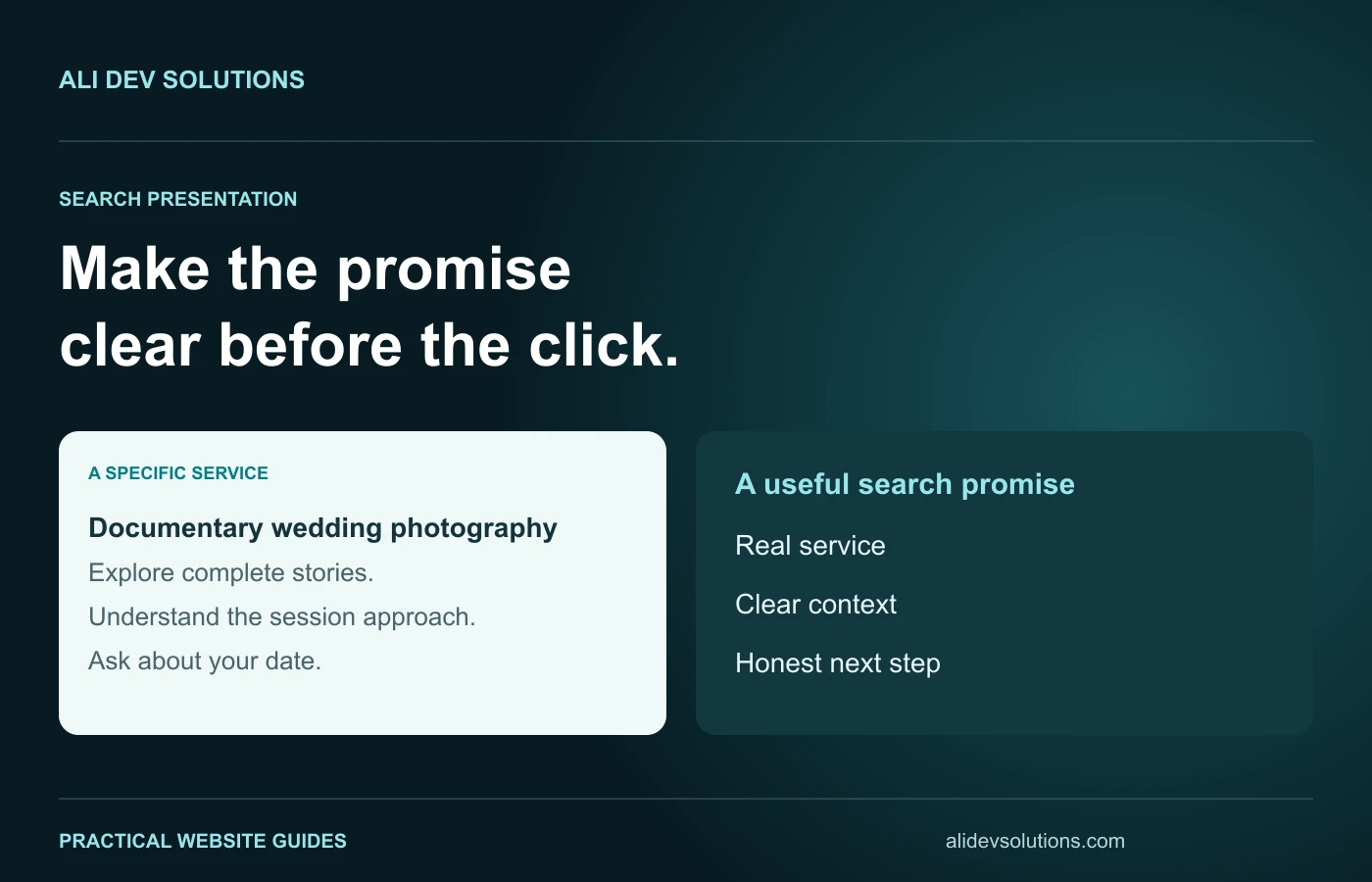
Useful SEO title and meta description examples begin with a real service and a clear visitor need. A photographer's wedding page, a consultant's discovery-call page and a developer's redesign page should not share the same generic promise, even when they belong to one business website.
Below are fictional examples for service businesses, followed by a method for adapting them. They are starting points for writing, not claims about a real company's results, location or availability. For the underlying editorial process, see our SEO titles and meta descriptions guide.
Understand what you are writing
The SEO title usually refers to the page's HTML title element. The main on-page heading introduces the visible page. The meta description offers a concise summary that may be used in a search snippet. They should agree about the page's purpose without needing to repeat exactly the same sentence.
Google explains that title links are generated from several signals, including page titles and visible headings. Your chosen wording influences presentation; it does not give you complete control over the displayed result.
Write the actual page before making a promise about it. If the page does not describe turnaround times, packages or service locations, those details do not belong in its search description.
Use a service-first title pattern
A practical starting structure is “specific service + useful context + business name.” Context might be the type of customer, genuine location or page format. It should help someone choose the result.
For example, “Commercial Product Photography | Sample Studio” tells a different story from “Wedding Photography in Bristol | Sample Studio.” A title such as “Home | Sample Studio” says little about either service.
Avoid adding every platform, city and service to one title. Give the most relevant detail priority, and check how the wording reads when the brand name is shortened or omitted. There is no universal character count that guarantees an unchanged display across every search layout.
Photography website examples
Wedding page title: Documentary Wedding Photography in Bristol | Sample Studio
Description: Explore relaxed wedding stories, see how a full day is documented and learn about coverage before asking Sample Studio about your date.
This example works only for a studio that genuinely serves Bristol and provides the promised information. It gives a reader a reason to explore beyond an attractive hero photograph.
Newborn page title: Newborn Photography Sessions | Sample Studio
Description: See newborn portrait examples, learn how sessions are planned and find practical preparation advice before enquiring about availability.
The second example avoids inventing a session length, safety certification or guaranteed delivery date. Add those details only when they are verified and explained on the page.
Website design and development examples
WordPress service title: WordPress Website Redesign for Service Businesses | Sample Digital
Description: Plan a clearer WordPress website with service pages, mobile layouts and an editable content setup. Explore the process and discuss your redesign brief.
Shopify service title: Shopify Store Design and Redesign | Sample Digital
Description: Explore Shopify design support for product discovery, collection layouts and checkout preparation. Review relevant work and discuss your store's needs.
These descriptions explain scope without promising first-place rankings or a fixed conversion increase. A business looking for a developer should be able to connect the search result with relevant examples and a sensible next step on the landing page.
Consultancy and appointment-based examples
Consultancy title: Operations Consulting for Small Teams | Sample Advisory
Description: Review practical operations consulting for growing teams, including process mapping and implementation planning. Learn what a discovery conversation covers.
Booking page title: Book a Website Planning Consultation | Sample Digital
Description: Share your website goals, current challenges and project priorities. See what to prepare for a planning conversation and choose an available appointment.
A booking page should accurately explain the appointment. Do not describe a paid consultation as free or imply a calendar is instantly available when the actual process begins with a manual request.
About and case-study page examples
About page title: About Sample Studio | Approach, Experience and Photography
Description: Meet the photographer behind Sample Studio, explore the approach to planning and photographing sessions, and find out how to discuss your project.
Case-study title: A Clearer Booking Journey for a Photography Studio | Sample Digital
Description: Explore a photography website project covering gallery structure, session information and enquiry design, with the project scope and decisions explained.
The case-study wording deliberately avoids an invented uplift. If a client has approved measured results, explain the measurement period and context on the page before using those results in a search description.
Adapt examples without producing duplicates
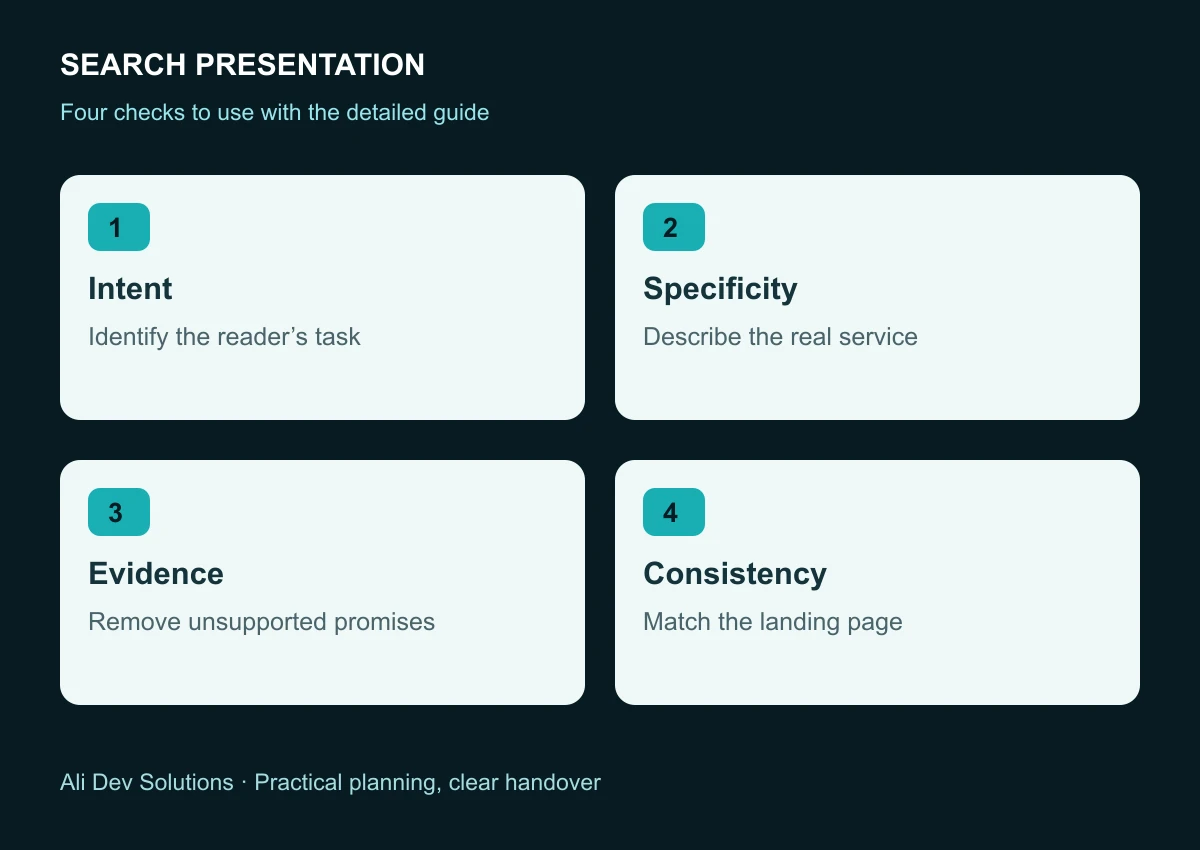
Create a small writing sheet with the URL, intended reader, main question, primary service, distinguishing detail and proposed next step. Draft the title from those fields, then write a description that summarises the actual page.
Consider two related pages: a general photography service and a wedding service. The first can explain the studio's range; the second should help couples evaluate wedding coverage. Swapping only one keyword in otherwise identical descriptions leaves both pages vague.
If several pages answer the same question, investigate their roles before writing more variations. Keyword mapping can help assign a clear purpose to each important address.
Replace unsupported language with useful detail
“Best,” “leading,” “award-winning” and “guaranteed” often appear because a writer has not identified the page's real distinction. Replace them with concrete information a visitor can verify.
“Explore complete wedding galleries” is more useful than “the ultimate photography experience” when the page actually contains those galleries. “Compare website redesign scope and handover” is more informative than “unlock digital success.”
Google's description guidance favours clear page-specific summaries over keyword lists. Treat the description as a small piece of helpful copy, not an extra place to repeat every phrase you want to rank for.
Review the whole search-to-enquiry journey
Open the landing page on a phone and compare it with the proposed snippet. Can a visitor immediately identify the promised service? Are relevant examples easy to find? Is the next step clear without covering the content with an intrusive overlay?
A result promising preparation advice should lead to that advice, not an unrelated sales introduction. A service result mentioning editable content should explain what the client can edit and how handover works.
Our service page SEO guide covers the broader content structure. Better snippets work best when the destination is useful enough to justify the click.
Measure changes in context
Record the old wording, new wording, publication date and reason for the change. Review Search Console by the relevant page and query group, with device and country filters when useful.
If a page appears mostly at low positions, a title edit alone may not solve its lack of clicks. If position, query mix and impressions change together, avoid attributing the entire outcome to the description. Search presentation is one part of a larger discovery process.
Use these examples to make your pages easier to understand, then refine them using relevant evidence. For help connecting your website copy, layout and service enquiry journey, contact Ali Dev Solutions.